


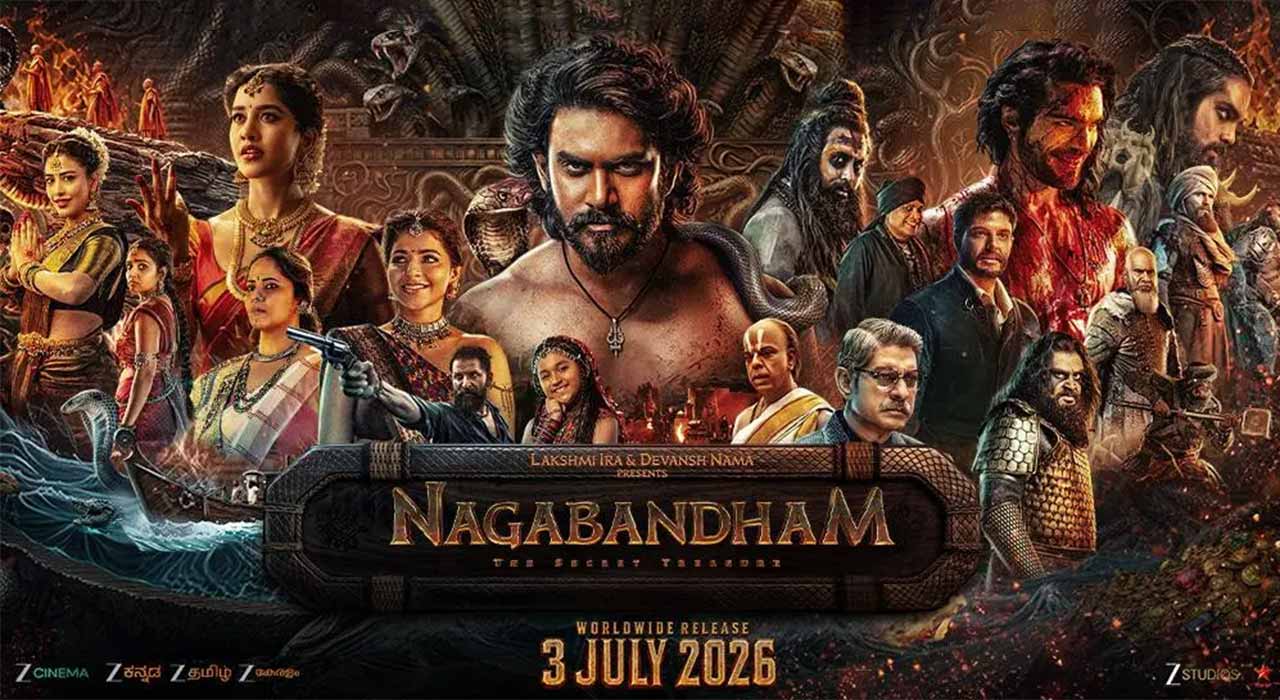
‘Nagabandham’ Review: Grand Visuals, Weak Writing
Sarkar Rating : 2.5/5 Release Date : July 3, 2026
Cast
Virat Karrna, Nabha Natesh, Iswarya Menon, Daksha Nagarkar, and others
Crew
Director : Abhishek Nama
Producers : Kishore Annapureddy, Nishitha Nagireddy
Music Director : Junaid Kumar – Abhe
Cinematographer : Soundararajan
Editor : RC Pranav
What is the Film About?
Drawing inspiration from Sanatana Dharma and ancient mythology, Nagabandham revolves around mankind’s eternal quest for immortality.
Rishabh, a mysterious man obsessed with conquering death, sets out in search of three sacred artifacts—the legendary Nagabandham, the divine Brahma Kamalam flower, and an ancient palm-leaf manuscript containing powerful Garuda mantras. The Brahma Kamalam and the manuscript are believed to be hidden inside the revered Ranganatha Swamy Temple at Srirangapuram.
Meanwhile, Rudra (Virat Karna), a humble boatman whose world revolves around his younger sister, dreams only of seeing her happily married to the man she loves. His ordinary life takes an extraordinary turn when fate entrusts him with the responsibility of protecting the sacred Brahma Kamalam.
As multiple forces race toward the same divine treasure—including Parvathi (Nabha Natesh) and Archaeology Department officer Prabhakar (Jagapathi Babu)—Rudra is drawn into a dangerous battle involving ancient secrets, mythology, and destiny. What follows forms the core of Nagabandham.
Analysis

Mythology-based films rooted in Sanatana Dharma continue to attract audiences, and Nagabandham attempts to capitalize on that growing interest. The writers weave fictional elements around legends associated with the Anantha Padmanabhaswamy Temple, creating a treasure-hunt adventure filled with ancient mysteries, hidden relics, and divine powers.
At its core, however, the film follows a familiar formula—a sacred temple, a priceless divine object, a ruthless antagonist determined to possess it, and a reluctant hero standing in the way. While the mythology adds freshness, the overall narrative remains predictable.
The film’s biggest strength is undoubtedly its ambition. The makers have mounted the project on a lavish scale, filling almost every frame with massive crowds, elaborate temple sets, large-scale action sequences, sea battles, snakes, crocodiles, and extensive visual effects. The production values are consistently impressive, and the recreation of the Anantha Padmanabhaswamy Temple stands out as one of the film’s visual highlights. However, the VFX quality fluctuates significantly, with some sequences looking convincing while others appear underwhelming.
Director Abhishek Nama deserves credit for choosing an intriguing premise with tremendous cinematic potential. Unfortunately, the execution doesn’t match the ambition. The storytelling lacks focus, the screenplay struggles to maintain momentum, and the narrative frequently loses direction.
The film evokes strong memories of Megastar Chiranjeevi’s Anji. Just as Anji revolved around the Atma Lingam, Nagabandham centers on the Brahma Kamalam, making the similarities difficult to ignore.
The opening portions are engaging and successfully establish mystery around the sacred artifact. However, the emotional track involving Rudra’s family and his sister’s marriage fails to create the intended impact, causing the narrative to slow considerably. The Bhairava Kona episode works reasonably well, but the songs that follow interrupt the flow instead of enhancing it.
The interval sequence, despite featuring an interesting twist and visually appealing moments, stretches far beyond necessity. Instead of delivering emotional intensity, it relies heavily on prolonged action and excessive violence, reducing its effectiveness.
The second half proves to be the film’s weakest segment. The pacing becomes increasingly sluggish, and several sequences feel repetitive. More importantly, the screenplay never clearly establishes why the villains desperately seek the Brahma Kamalam or what catastrophic consequences await if they succeed. This missing emotional and narrative urgency significantly weakens the central conflict.
The revelation of Rudra’s past life arrives only shortly before the climax, making it feel less like a satisfying payoff and more like delayed exposition. Historical episodes depicting temple invasions and oppression, though competently staged, offer little novelty since similar sequences have appeared in numerous films. Likewise, the lengthy speeches on Sanatana Dharma during the climax feel inserted more to align with current cinematic trends than to organically serve the story.
Ultimately, despite its grand ambition, Nagabandham struggles because its screenplay fails to transform an interesting concept into an emotionally engaging adventure.
Performances


Virat Karna shoulders a demanding role that perhaps exceeds his current star power. Nevertheless, he delivers a sincere performance and handles the action sequences with confidence. His transformation into the Naga Sadhu is visually striking and ranks among his better moments in the film.
Nabha Natesh has a comparatively stronger role than expected and performs convincingly within the limited scope offered by the screenplay. Rishabh leaves a noticeable impression despite limited screen time.
Veteran actors Jagapathi Babu, Murali Sharma, Mahesh Manjrekar, Anasuya Bharadwaj, and Aishwarya Menon are part of the extensive supporting cast but receive limited opportunities to make a lasting impact.
Technical Aspects
Technically, Nagabandham is mounted on a grand scale. The production design deserves special appreciation, particularly the magnificent recreation of the Anantha Padmanabhaswamy Temple, which brings authenticity and spiritual grandeur to the film.
The cinematography effectively captures the film’s scale, while the action choreography complements the mythological setting. The background score supports several crucial moments, although it occasionally becomes overpowering.
The biggest technical drawback is the film’s excessive runtime of 3 hours and 15 minutes. Nearly half an hour could have been trimmed without affecting the story. A tighter edit and a more focused screenplay would have significantly improved the overall experience.
Verdict
Nagabandham is an ambitious mythological fantasy that impresses with its lavish visuals, grand production design, and scale. However, impressive visuals alone cannot compensate for weak storytelling. The inconsistent screenplay, overlong runtime, and lack of emotional depth prevent the film from realizing its full potential.
Read Also: Sing Geetham Review A Refreshingly Unique Musical Fable with Heart