


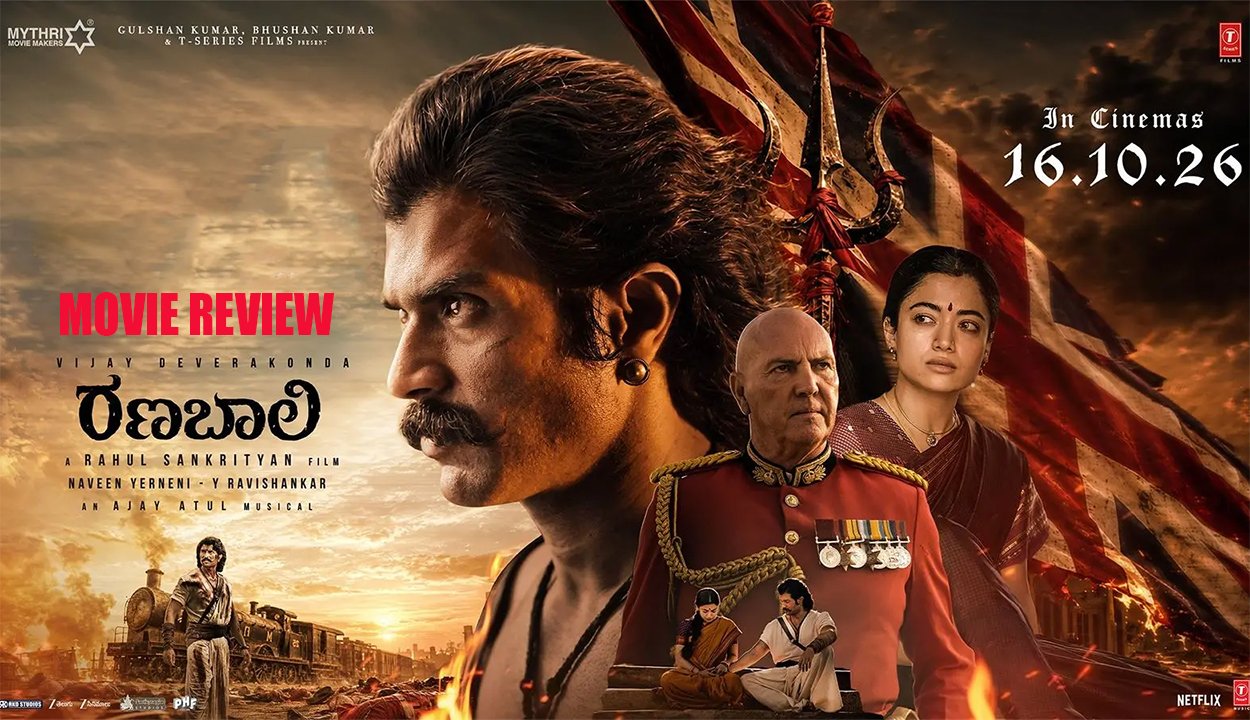
Ranabaali Review: A Lengthy, Emotionally Flat Period Drama
Sarkar Rating: NR Release Date : October 16, 2026
Cast: Vijay Deverakonda, Rashmika Mandanna, Arnold Vosloo
Story, Screenplay & Direction: Rahul Sankrityan
Music: Ajay-Atul
Cinematography: Jishnu Bhattacharjee, Nirav Shah
Editing: Karthika Srinivas R
Producers: Naveen Yerneni, Y. Ravi Shankar
Presented By: Gulshan Kumar, Bhushan Kumar, T-Series Films
Production House: Mythri Movie Makers
What Is the Film About?
Ranabaali takes us back to the British colonial era, portraying the exploitation, cruelty and suffering inflicted on Indians under British rule. Driven by greed, the British plunder the country’s resources, leaving ordinary people to endure poverty, starvation and oppression. Against this backdrop, the film follows the rise of Ranabaali, a fierce warrior who stands up against the injustice and fights to restore dignity and hope to his people.
Performances
Vijay Deverakonda attempts a significant transformation with his portrayal of Ranabaali. His appearance, body language and distinctive slang are noticeably different from his previous roles. However, the unfamiliar mannerisms take some time to settle in, and his dialogue delivery and characterization do not always work in his favour. Despite these shortcomings, his commitment to the role is evident. A more effective styling approach could have highlighted his height and physique, giving the character a more imposing and ferocious warrior presence.
Rashmika Mandanna delivers a decent performance as Jayamma. She handles the emotional sequences reasonably well and makes an impression in a few important moments. However, the writing does not provide enough depth for her character to leave a lasting impact.
Arnold Vosloo is well cast as the ruthless British officer. His imposing screen presence suits the character, and he effectively conveys the brutality expected of the antagonist.
The film also features a sizeable supporting cast, including several unfamiliar faces. While the ensemble contributes to the period setting, most of the supporting characters are not developed sufficiently to make a strong impression.
Analysis

Director Rahul Sankrityan, who previously collaborated with Vijay Deverakonda on Taxiwaala, chooses a historically charged subject for Ranabaali. The film attempts to bring to the screen the painful realities of colonial exploitation, focusing on the suffering of ordinary Indians and their struggle against British oppression.
The subject has considerable emotional potential. The depiction of starvation, the exploitation of agricultural wealth and the cruelty inflicted on innocent people should naturally evoke anger and sympathy. Certain sequences, supported by on-screen text and emotionally charged situations, communicate the gravity of the subject. However, the film struggles to translate its powerful premise into an equally compelling cinematic experience.
The nearly three-hour runtime becomes a major drawback. A lengthy period drama can work when its narrative is engaging and its emotional moments are sufficiently powerful. Unfortunately, Ranabaali suffers from slow pacing, repetitive scenes and an unnecessarily prolonged narrative that gradually tests the audience’s patience.
The film contains considerable violence, and Ranabaali’s fight against the British is intended to generate anger towards the oppressors and make viewers root for the protagonist. However, the action sequences lack the emotional buildup required to make them truly impactful. Major moments, including the interval block and the sequence in which Ranabaali retrieves food seized by the British and returns it to the starving people, should have been powerful highlights. Instead, the execution fails to deliver the expected intensity.
There are occasional emotional moments in both halves, but their impact is weakened by the sluggish narration and repetitive storytelling. Rather than allowing the characters and situations to build genuine emotional momentum, the film frequently relies on loud presentation and dramatic staging. As a result, several sequences feel more exhausting than moving.
The dialogue delivery and characterization of some British officers speaking Telugu may also remind viewers of a dubbed Hollywood film. While this is not a major issue by itself, it occasionally affects the natural flow of the proceedings.
Another noticeable drawback is the repeated use of the word “Neeyakka” in Vijay Deverakonda’s dialogues. What might initially appear to be a character-specific expression soon becomes repetitive and distracting. Better control over the dialogue and a more restrained approach could have made the characterisation more effective.
Ultimately, Ranabaali has a relevant subject and an ambitious canvas, but its storytelling lacks the sharpness and emotional depth needed to make the experience memorable. The film attempts to communicate the pain of an oppressed population, yet its excessive length and uneven execution prevent those emotions from resonating as strongly as intended.
Music and Technical Departments
Ajay-Atul’s music is one of the film’s major disappointments. Despite the scale of the narrative and the emotional intensity of the subject, the songs and background score fail to create memorable cinematic highs. The background music frequently adds to the loudness without significantly elevating the emotional impact of key sequences.


Cinematography is among the film’s strongest aspects. Jishnu Bhattacharjee and Nirav Shah capture the period setting with impressive visual detail. The landscapes, compositions and large-scale sequences contribute to the film’s visual appeal.
The production design and sets deserve appreciation for recreating the colonial-era atmosphere. The locations, costumes and overall visual presentation lend authenticity to the period drama. Mythri Movie Makers deserve credit for mounting the film on a grand scale and maintaining strong production values.
However, the editing falls short of expectations. Both halves feel unnecessarily stretched, and several scenes could have been shortened or removed to improve the narrative flow. A tighter edit would have made the film more engaging and allowed its important emotional and action sequences to make a greater impact.
Verdict
Ranabaali is an ambitious period drama built around a powerful theme of colonial exploitation and resistance. Vijay Deverakonda’s sincere effort, the impressive cinematography and the authentic production design work in its favour. However, weak narrative execution, sluggish pacing, repetitive dialogue, underwhelming music and an excessive runtime prevent the film from achieving its full potential.
Despite its grand scale and serious intentions, Ranabaali struggles to turn its emotionally charged subject into a compelling theatrical experience. A sharper screenplay and substantial trimming could have made a significant difference.