


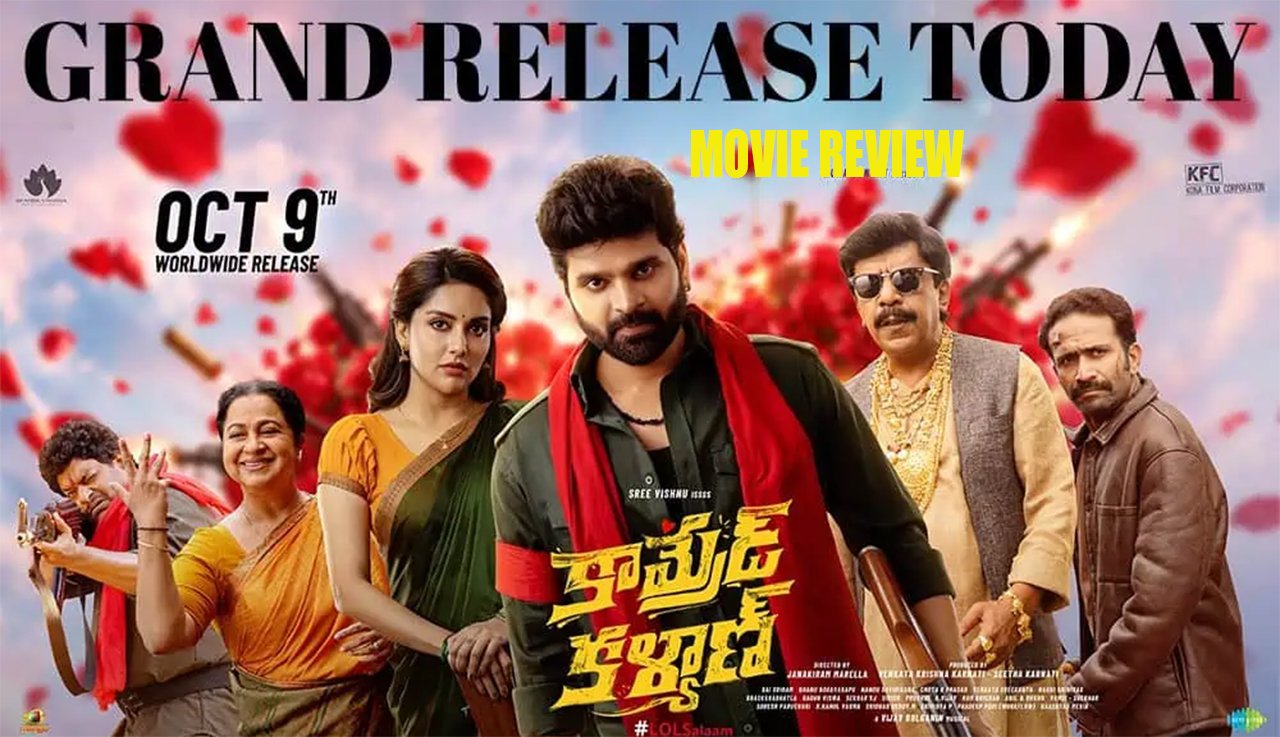
Comrade Kalyan Movie Review: Sree Vishnu and Satya Deliver Plenty of Laughs
Sarkar Rating: 2.5/5 Release Date : October 09, 2026
Cast: Sree Vishnu, Mahima Nambiar, Satya, Shine Tom Chacko, Sudarshan, Radhika Sarathkumar, Sai Chand, Shatru, Upendra Limaye and others
Director: Janakiram Marella
Music:Vijay Bulganin
Cinematography:Sai Sriram
Story and Screenplay:Bhanu, Nandu and Kona Venkat
Producer:Venkata Krishna
What Is the Film About?
Sree Vishnu began his career with serious films before gradually establishing himself as one of Telugu cinema’s dependable comedy entertainers. With films such as Samajavaragamana, Single and Swag, he has earned a reputation for his distinctive humour and impeccable comic timing. He now returns with Comrade Kalyan, a comedy entertainer that places its protagonist in the unusual backdrop of Naxalism.
Has Sree Vishnu managed to deliver another entertaining outing? Let’s find out.
Story
Kalyan (Sree Vishnu) is a young man living in Madugula, a village in undivided Andhra Pradesh during the 1990s, when Naxalite activity was prominent in the region. He runs a local theatre on lease and leads an ordinary life until he falls in love with Sitara Devi (Mahima Nambiar), an Odia girl who has recently arrived in the village.
As the story progresses, Kalyan discovers that Sitara is actually a Telugu girl caught in a serious predicament. In an unexpected turn of events, he finds himself compelled to assume the identity of a Naxalite to help her escape from her troubles.
What begins as a seemingly simple attempt to help the woman he loves soon turns into a complicated situation. Kalyan gets caught between actual Naxalites and the police, forcing him to navigate a dangerous game of deception and survival.
What exactly is Sitara’s problem? Why does Kalyan have to enter the world of Naxalism? Will he manage to escape from the dangerous situation he has landed in? The rest of the film revolves around these questions.
Analysis
Naxalism is a serious and sensitive subject. A film built around a protagonist who enters the world of Naxalites naturally creates expectations of tension, danger and intense drama. Given Sree Vishnu’s recent run of comedy entertainers, the idea of placing him in such a setting initially raises an interesting question: how will the director balance humour with a serious backdrop?
The promotional material makes it clear that Comrade Kalyan is primarily a comedy entertainer. However, the challenge lies in making the humour work without weakening the central conflict. Unfortunately, this is where the film struggles.

The basic premise is genuinely interesting. An ordinary young man assumes the identity of a Naxalite for personal reasons and unexpectedly finds himself trapped between real Naxalites and the police. With a tightly written screenplay, this premise could have resulted in a distinctive and highly entertaining film.
Instead, the narrative frequently takes the easier route. Several situations unfold in a convenient and overly simplistic manner, making it difficult to take the characters and their circumstances seriously. The Naxalites sometimes come across as unnecessarily foolish, while the police fail to generate the kind of tension expected from their pursuit. Kalyan, meanwhile, appears to outsmart both sides with surprising ease.
Sree Vishnu has maintained that the situations in the film are meant to be serious, with the humour emerging naturally from how the audience perceives them. However, the narrative does not consistently establish the seriousness required to make this approach effective. Most of the conflicts are handled in a light-hearted manner, reducing the impact of several potentially compelling moments.
Another major drawback is the emotional foundation of Kalyan’s decision. He risks his life to help Sitara, but their romantic relationship is not developed convincingly enough to establish the emotional stakes. As a result, his transformation into a Naxalite does not carry the weight it should.
The sequences involving the Naxalite group, the police investigation and the kidnapping of a minister offer opportunities for gripping drama and situational comedy. Yet, the screenplay rarely explores these situations with sufficient depth or intensity. The second half, in particular, struggles to sustain the curiosity generated before the interval.
That said, the film is not without its strengths. If viewers set aside the logical inconsistencies and watch it primarily for entertainment, Comrade Kalyan offers several enjoyable moments. The comedy remains its biggest asset, with Sree Vishnu’s trademark sarcasm and punchlines providing much of the fun.
The film also features references to other movies and humorous jabs at the film industry. These moments work well, particularly when Sree Vishnu turns the humour on himself. The combination of familiar comic elements and situational humour ensures that the film remains watchable even when the narrative loses momentum.
The interval block raises expectations for an engaging second half, but the film does not fully capitalise on that opportunity. Although the latter portions feature occasional laughs, the uneven screenplay prevents the narrative from delivering a satisfying overall experience. The film eventually concludes with a message, but the journey towards that conclusion lacks the emotional and dramatic impact needed to make it memorable.
Ultimately, Comrade Kalyan is neither a completely disappointing film nor a particularly memorable entertainer. It offers enough humour to provide a reasonably enjoyable theatrical experience, provided viewers approach it with modest expectations.
Performances
Sree Vishnu is perfectly suited to the comic nature of Kalyan’s character. His effortless delivery, sarcastic one-liners and expressive reactions keep the entertainment quotient alive throughout the film. He delivers the kind of humour audiences have come to expect from him and also handles a few emotional moments effectively.
Mahima Nambiar looks appealing and delivers a decent performance as Sitara. Although her character lacks sufficient depth and development, she makes a sincere effort with the material provided.
Satya emerges as one of the film’s biggest strengths. His comic timing, facial expressions and dialogue delivery generate several genuine laughs. In a few sequences, he even manages to steal the spotlight from Sree Vishnu. The chemistry between the two comedians works particularly well, making their combination one of the film’s most enjoyable aspects.
Sudarshan contributes to the humour with a decent performance, while Vennela Kishore makes the most of his limited screen time, delivering a few entertaining moments.


Sai Chand and Shatru are effective as Naxalite leaders, bringing credibility to their respective roles. Shine Tom Chacko, however, does not make the expected impact as a police officer. His character lacks a clearly defined balance between comedy and seriousness, leaving the performance less effective than it could have been.
Radhika Sarathkumar’s character initially creates curiosity, but the writing does not give her enough scope to make a lasting impression. Upendra Limaye’s comic track also fails to generate the desired impact. Srikanth Iyengar, Raghu Babu, Sarayu and the remaining supporting actors perform adequately.
Technical Aspects
Sai Sriram’s cinematography is one of the film’s strongest technical assets. His visuals capture the rural atmosphere and forest locations effectively, adding natural beauty and authenticity to the setting. The cinematography remains appealing throughout and enhances the film’s visual quality.
Vijay Bulganin’s music is reasonably effective. While the songs make a moderate impression, the track featuring the Odia girl stands out for its pleasant melody. The background score supports the proceedings adequately.
The production values are good, with the makers ensuring that the film maintains a decent technical standard. The locations, visual presentation and overall production quality meet the requirements of the story.
The main shortcoming lies in the writing. Bhanu and Nandu, who earned recognition for their comic writing in Samajavaragamana, along with Kona Venkat, come up with an interesting central premise and several entertaining comic situations. However, the screenplay lacks the tightness required to bring the various elements together convincingly.
Director Janakiram Marella demonstrates a reasonable command over comedy. Several scenes showcase his ability to generate humour through dialogue and situations. However, he does not give the serious portions enough weight, resulting in an uneven blend of comedy and drama.
Verdict
Comrade Kalyan has an interesting premise, Sree Vishnu’s dependable comic timing and Satya’s entertaining performance working in its favour. However, a loosely written screenplay, underdeveloped emotional elements and a lack of seriousness in handling the central conflict prevent the film from reaching its full potential.
While the first half offers some enjoyable comedy and the interval generates curiosity, the second half fails to maintain the momentum. Nevertheless, the film has enough funny moments to keep audiences entertained in parts.
Read Also: DC Movie Review: A Raw and Riveting Reimagination of Devadas