


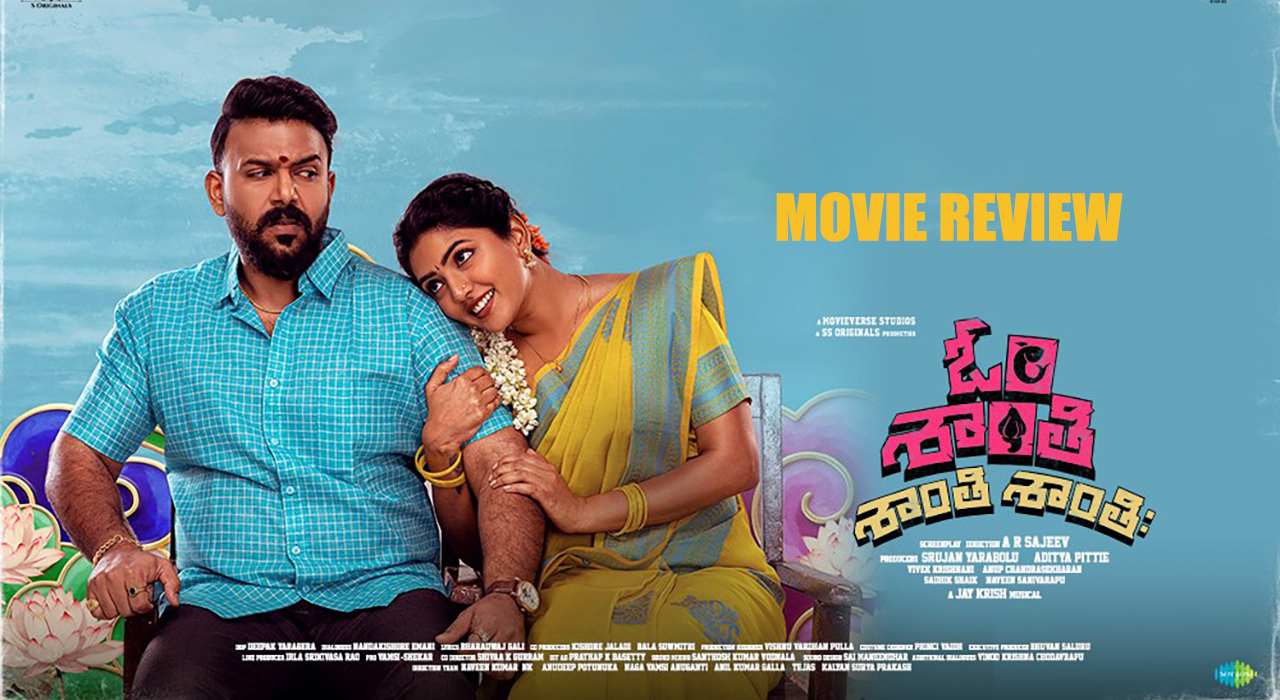
Om Shanti Shanti Shantihi Review: A Promising First Half Undone by a Weak Finale
Sarkar Rating:2.5/5 Release Date : Jan 30, 2026
Cast
Tharun Bhascker Dhaassyam, Eesha Rebba, Brahmaji and others
Crew
Director : A R Sajeev
Producers : Srujan Yarabolu, Aditya Pittie, Vivek Krishnani, Anup Chandrasekharan, Sadhik shaik, Naveen Sanivarapu
Music Director : Jay Krish
Cinematographer : Deepak Yaragera
Editor : AR Sajeev
What Is the Film About?
At its core, Om Shanti Shanti Shantihi is a social drama that addresses gender inequality and male dominance within a traditional setup. The story follows Shanti (Eesha Rebba), a woman with modest dreams, whose journey is shaped by the challenges she faces in a male-dominated society. The film revolves around her fight for self-respect and dignity, forming the emotional backbone of the narrative.
Performances
Tharun Bhascker, playing Naidu, is a perfect casting choice. From his physicality to his understated body language, he fits the role effortlessly. His performance is restrained, natural, and never over-the-top. He leaves a strong impression, particularly in the first half, and is a major reason the film remains engaging early on.
Eesha Rebba, as Shanti, feels slightly miscast during the initial school portions. Those sequences lack conviction and fail to create an immediate emotional connect. However, as the story progresses—especially after her character transitions into married life—she grows into the role and delivers a sincere, convincing performance.

Analysis
Directed by A R Sajeev, the film opens with a pleasant song and establishes its central theme early on. However, the initial staging feels somewhat inorganic. The school portions and the love track involving the teacher come across as weak and fail to leave a strong first impression.
Once the narrative moves past this phase and enters Shanti’s married life, the film finds its rhythm. From the point where the marital dynamic between Eesha Rebba and Tharun Bhascker is established, the storytelling becomes smooth and engaging until the interval. The humor here is subtle and organic, never forced or inserted merely for laughs. Despite many scenes revolving around the couple, they do not feel repetitive due to the clarity of intent and structured writing.
Well-written dialogues enhance the humor and blend seamlessly into the narrative. Casting, especially Tharun Bhascker’s, plays a crucial role in making the first half work despite the shaky opening. Supported by effective music, the first half turns out to be neat and enjoyable overall.
The second half begins on a promising and entertaining note, featuring an over-the-top yet thematic action-fight sequence between the couple. This is followed by a fun and well-executed settlement scene involving Brahmaji and the family, which stands out as one of the better blocks in the latter half.
Unfortunately, from that point until the climax, the film loses steam. Several portions feel dull and disengaging. The narrative becomes patchy, especially with Eesha Rebba’s business track, which feels underdeveloped and disconnected from the main plot. Emotional moments fail to land, disrupting the overall flow.
The most disappointing aspect is the final block involving the divorce and courtroom proceedings. Despite being crucial to the film’s theme, this segment lacks impact and emotional depth, resulting in an unsatisfying conclusion.
Performances by Other Actors

Among the supporting cast, Brahmaji stands out with an excellent performance. His expressive body language and timing align perfectly with the writing, allowing him to steal a few scenes. The rest of the cast—including the parents and extended family members—are well-cast and deliver neat, effective performances that fit naturally into the film’s setup.
Music and Technical Aspects
Jay Krish’s music is a major strength of the film. Beyond the popular song, the background score and situational tracks significantly elevate the narrative’s emotional tone. Cinematography by Deepak Yaragera is neat and authentic, complementing the film’s grounded setting. Editing, handled by the director and his team, needed to be tighter—particularly in the second half, where several scenes could have been trimmed. Production values from S Originals and MovieVerse Studios are decent and suit the film’s simple, family-oriented theme.
Verdict
Om Shanti Shanti Shantihi works well in parts, delivering a fun-filled and engaging first half, driven by strong performances and organic humor. However, a weak and uneven second half, coupled with an underwhelming climax, prevents it from reaching its full potential.
Read Also: Bhartha Mahasayulaki Wignyapthi Review: a Fun Festive Entertainer