


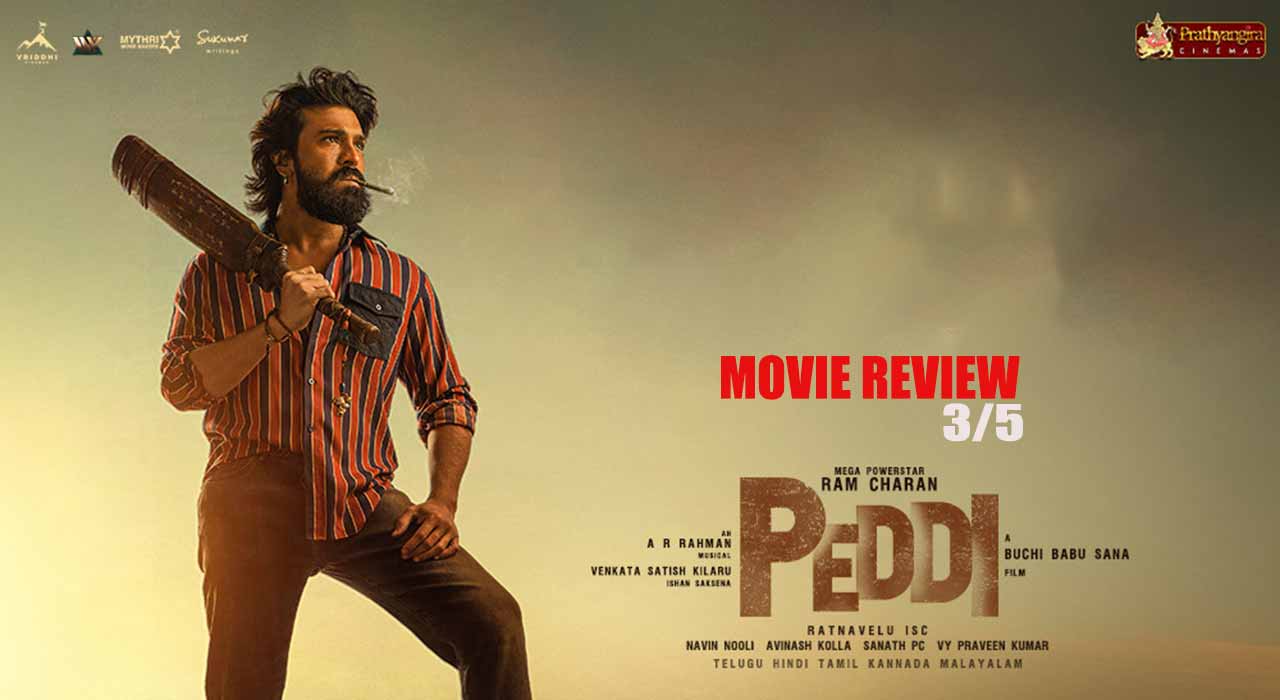
Peddi Review: Ram Charan Powers an Emotional Sports Drama
Sarkar Rating: 3/5 Release Date : June 4, 2026
Cast
Ram Charan, Janhvi Kapoor, Shiva Rajkumar, Jagapathi Babu, Divyendu Sharma
Crew
Director : Buchi Babu Sana
Producers : Venkata Satish Kilaru
Music Director : AR Rahman
Cinematographer : Ratnavelu ISC
Editor : Navin Nooli
What’s Peddi About?
Set against the backdrop of rural Andhra Pradesh, Peddi unfolds through a flashback narrative. In 2016, a representative from a national sports academy (Boman Irani) arrives in Vizianagaram on a talent-hunting mission after being questioned about the lack of Olympic-level athletes emerging from the region. During his visit, he repeatedly hears one name spoken with admiration and reverence — Peddi.
Curious about the legend surrounding him, the official begins piecing together Peddi’s story through the memories of local residents.
The narrative then travels back to the early 1990s, to an isolated settlement hidden at the foothills of a mountain. Though hundreds of people live there, the village has no official identity and remains absent from government records. The residents struggle without recognition, infrastructure, or even a name on the map.
Among them is Peddi (Ram Charan), a spirited young man employed at a sugar factory who supplements his income as an “aata kooli,” a player-for-hire in local cricket tournaments. He is deeply in love with Achiyamma (Janhvi Kapoor), the daughter of the village sarpanch. Their relationship blossoms after Peddi protects her from an incident that threatens her dignity.
At the same time, Appalasuri (Jagapathi Babu) is fighting tirelessly to secure a railway halt for the village. For him, the railway station represents far more than transportation—it symbolizes recognition, development, and a long-overdue identity for an entire community.
When tragedy strikes, Peddi takes it upon himself to carry forward Appalasuri’s dream. What follows is an inspiring journey that transforms him from a carefree village cricketer into a nationally recognized athlete. Guided by his mentor (Shiva Rajkumar), Peddi evolves into a formidable wrestler whose path eventually takes him all the way to Delhi, where his personal ambitions merge with the hopes of an entire village.
Analysis
With Peddi, director Buchi Babu Sana attempts a film that is far more ambitious than a conventional sports drama. It combines sports, social commentary, village politics, romance, and emotional storytelling into one expansive narrative.

At its core, the story follows a familiar cinematic blueprint—a carefree young man gradually evolves into a leader capable of bringing change to his people. While the trajectory itself isn’t groundbreaking, the emotional foundation remains engaging enough to keep audiences invested.
Initially, sports are merely a source of pride and self-expression for Peddi. His talent reflects his confidence, swagger, and youthful arrogance. However, following a life-altering tragedy, sports acquire a deeper purpose. What starts as a personal passion transforms into a mission to earn recognition and dignity for a forgotten community.
This thematic shift is where Peddi finds its strongest footing. The idea of an athlete carrying the aspirations of an invisible village is emotionally powerful and socially relevant.
Unfortunately, the film’s execution doesn’t always match the strength of its intentions.
The biggest issue lies in the narrative framework involving Boman Irani’s character. The flashback structure raises several logical questions. Since Peddi’s achievements eventually become national history, it feels implausible that a senior sports official in 2016 would know so little about him. What begins as an intriguing storytelling device gradually becomes one of the film’s weakest narrative choices.

The first half also spends excessive time on the romance between Peddi and Achiyamma. While the chemistry is pleasant, these sequences feel formulaic and often slow down the narrative. Several scenes appear designed more for commercial appeal than for meaningful character development.
The film truly finds its emotional pulse when Jagapathi Babu’s Appalasuri takes center stage. His storyline injects urgency, purpose, and emotional depth into the proceedings. From this point onward, the stakes become clearer and the narrative gains momentum.
Buchi Babu recognizes that the story itself follows a familiar template, so he relies heavily on characterization, emotional drama, and social messaging. His sincerity is evident throughout the film, and there are several moments where that conviction successfully connects with the audience.
However, the screenplay often lacks discipline. Several supporting characters are introduced but contribute very little to the overall narrative. Talented actors like Rao Ramesh, John Vijay, and Ajay Ghosh remain largely underutilized. The second half also suffers from pacing issues, with certain songs and an item number interrupting the emotional flow rather than enhancing it.
Performances
The film belongs entirely to Ram Charan.
After acclaimed performances in Rangasthalam and RRR, Charan once again proves why he is among the finest performers in contemporary Telugu cinema. Peddi may well rank among the best performances of his career.
His physical transformation is remarkable, particularly during the wrestling portions, where he brings extraordinary authenticity and intensity to the role. More importantly, he shines in the emotional scenes. Whether portraying grief, determination, vulnerability, or resilience, Charan commands attention in every frame. His dedication to the character is visible throughout the film and elevates several scenes that might otherwise have fallen flat.
Janhvi Kapoor performs adequately and brings grace to the role of Achiyamma, though the character itself lacks depth. Jagapathi Babu is outstanding and delivers one of the film’s strongest performances. His emotional journey forms the heart of the narrative and provides some of its most memorable moments.


Shiva Rajkumar brings warmth, wisdom, and gravitas to his mentor role, while Divyenndu Sharma leaves a decent impression despite limited screen time.

Technical Aspects
Technically, Peddi is a commendable achievement.
AR Rahman’s background score significantly enhances the emotional weight of the film and emerges as one of its strongest assets. Several key moments gain additional impact because of his music. The songs, particularly “Rai Rai Raa Raa” and “Chikiri Chikiri,” are catchy and blend naturally into the rural setting.
R. Rathnavelu’s cinematography is consistently impressive. The visuals beautifully capture the rustic atmosphere and period setting. The decision to shoot portions on film stock reportedly adds authenticity and texture to the narrative.
Avinash Kolla deserves special praise for his production design, which meticulously recreates the era and environment. The dialogues effectively capture local flavor and cultural nuances.
Editing, however, remains one of the weaker aspects. The lengthy runtime and uneven pacing frequently test audience patience, especially during the first half and portions of the latter stages.
Verdict
Peddi is an earnest and emotionally driven sports drama that combines personal ambition with a larger social cause. While Buchi Babu’s writing occasionally struggles with pacing issues, logical inconsistencies, and unnecessary detours, the film’s emotional core remains effective.
What ultimately makes Peddi work is Ram Charan’s exceptional performance, backed by strong support from Jagapathi Babu and impressive technical craftsmanship. The sports drama may follow a familiar path, but its message about identity, recognition, and collective pride gives it enough emotional weight to leave an impact.
Despite its flaws, Peddi emerges as an engaging big-screen experience powered by heartfelt storytelling, powerful performances, and memorable emotional moments.
Read Also: GaayaPadda Simham Review: A Quirky Idea That Loses Its Roar